> ## Documentation Index
> Fetch the complete documentation index at: https://cubed3-feat-druid-driver-streaming.mintlify.site/llms.txt
> Use this file to discover all available pages before exploring further.
# Calculating nested aggregates
> Express aggregates-of-aggregates—such as a median of per-group sums—by splitting inner and outer rollups across joined cubes and subquery dimensions.
## Use case
Sometimes, there's a need to calculate a double aggregation over a fact
table. For example, if you have a `line_items` table that has `store_id`,
`order_id`, and `sales` columns, you might wonder what is the median of
*sales per product* for each store.
With an ad-hoc SQL query, this double aggregation would probably
be expressed as follows:
```sql theme={null}
WITH sales_per_store_product AS (
SELECT store_id, product_id, SUM(sales) AS sales
FROM line_items
GROUP BY 1, 2
)
SELECT store_id, PERCENTILE_CONT(0.5) WITHIN GROUP (ORDER BY sales) AS sales_median
FROM sales_per_store_product
GROUP BY 1
```
## Data modeling
In Cube, [measures][ref-measures] are used to define aggregates. However,
a single measure can only contain a single aggregation, e.g., `SUM`,
`APPROX_COUNT_DISTINCT`, or `PERCENTILE_CONT`.
If you'd like to define a double aggregation, e.g., a median of a sum of
values, the *outer* aggregation would need to be defined in a separate
[cube][ref-cube] and the *inner* aggregation (measure) would need to be
brought to that cube as a [subquery dimension][ref-subquery-dimension].
Also, these cubes would need to have a join definition between them.
Consider the following data model:
```yaml theme={null}
cubes:
- name: nested_agg_sales
sql: |
SELECT 1 AS id, 1 AS store_id, 1 AS product_id, 10 AS sales UNION ALL
SELECT 2 AS id, 1 AS store_id, 1 AS product_id, 20 AS sales UNION ALL
SELECT 3 AS id, 1 AS store_id, 2 AS product_id, 30 AS sales UNION ALL
SELECT 4 AS id, 1 AS store_id, 2 AS product_id, 40 AS sales UNION ALL
SELECT 5 AS id, 2 AS store_id, 1 AS product_id, 50 AS sales UNION ALL
SELECT 6 AS id, 2 AS store_id, 1 AS product_id, 60 AS sales UNION ALL
SELECT 7 AS id, 2 AS store_id, 2 AS product_id, 70 AS sales UNION ALL
SELECT 8 AS id, 2 AS store_id, 2 AS product_id, 80 AS sales
dimensions:
- name: id
sql: id
type: number
primary_key: true
- name: store_id
sql: store_id
type: number
- name: product_id
sql: product_id
type: number
- name: store_product_id
sql: "CONCAT({store_id}, '-', {product_id})"
type: string
measures:
- name: sales
sql: sales
type: sum
- name: nested_agg_stores_orders
sql: |
SELECT store_id, product_id
FROM (
SELECT 1 AS id, 1 AS store_id, 1 AS product_id, 10 AS sales UNION ALL
SELECT 2 AS id, 1 AS store_id, 1 AS product_id, 20 AS sales UNION ALL
SELECT 3 AS id, 1 AS store_id, 2 AS product_id, 30 AS sales UNION ALL
SELECT 4 AS id, 1 AS store_id, 2 AS product_id, 40 AS sales UNION ALL
SELECT 5 AS id, 2 AS store_id, 1 AS product_id, 50 AS sales UNION ALL
SELECT 6 AS id, 2 AS store_id, 1 AS product_id, 60 AS sales UNION ALL
SELECT 7 AS id, 2 AS store_id, 2 AS product_id, 70 AS sales UNION ALL
SELECT 8 AS id, 2 AS store_id, 2 AS product_id, 80 AS sales
) AS raw
GROUP BY 1, 2
joins:
- name: nested_agg_sales
sql: "{nested_agg_stores_orders.store_product_id} = {nested_agg_sales.store_product_id}"
relationship: one_to_many
dimensions:
- name: store_id
sql: store_id
type: number
- name: product_id
sql: product_id
type: number
- name: store_product_id
sql: "CONCAT({store_id}, '-', {product_id})"
type: string
primary_key: true
- name: sales_sum
sql: "{nested_agg_sales.sales}"
type: number
sub_query: true
measures:
- name: median_sales
sql: "PERCENTILE_CONT(0.5) WITHIN GROUP (ORDER BY {sales_sum})"
type: number
```
As you can see, the sum of sales for per store and per product is defined
in the `nested_agg_sales` cube as the `sales` measure. Then, it is brought
to the `nested_agg_stores_orders` cube as `sales_sum` that is defined as
a subquery dimension. Also, a join is defined between both cubes.
Then, the median of sales is defined as the `median_sales` measure in the
`nested_agg_stores_orders` cube. It’s OK to reference `sales_sum` in this
measure because now it's a dimension; referencing a measure from another
cube here would not work.
## Result
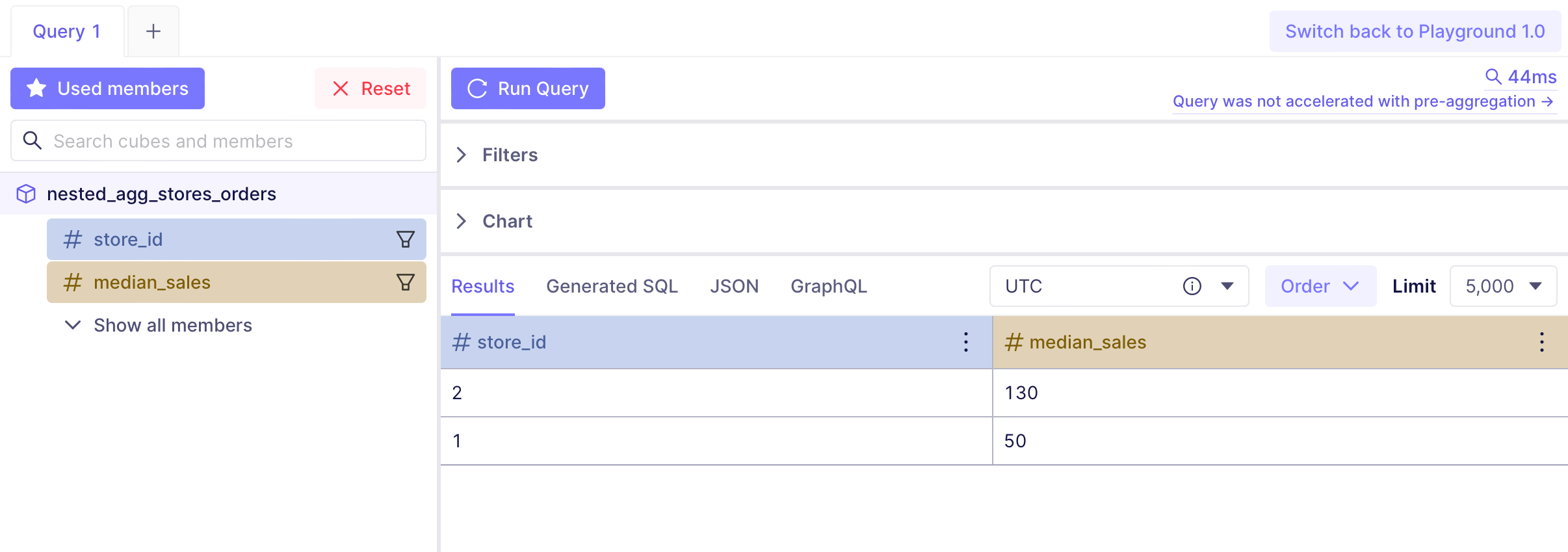
Querying the `median_sales` measure would give the expected result:
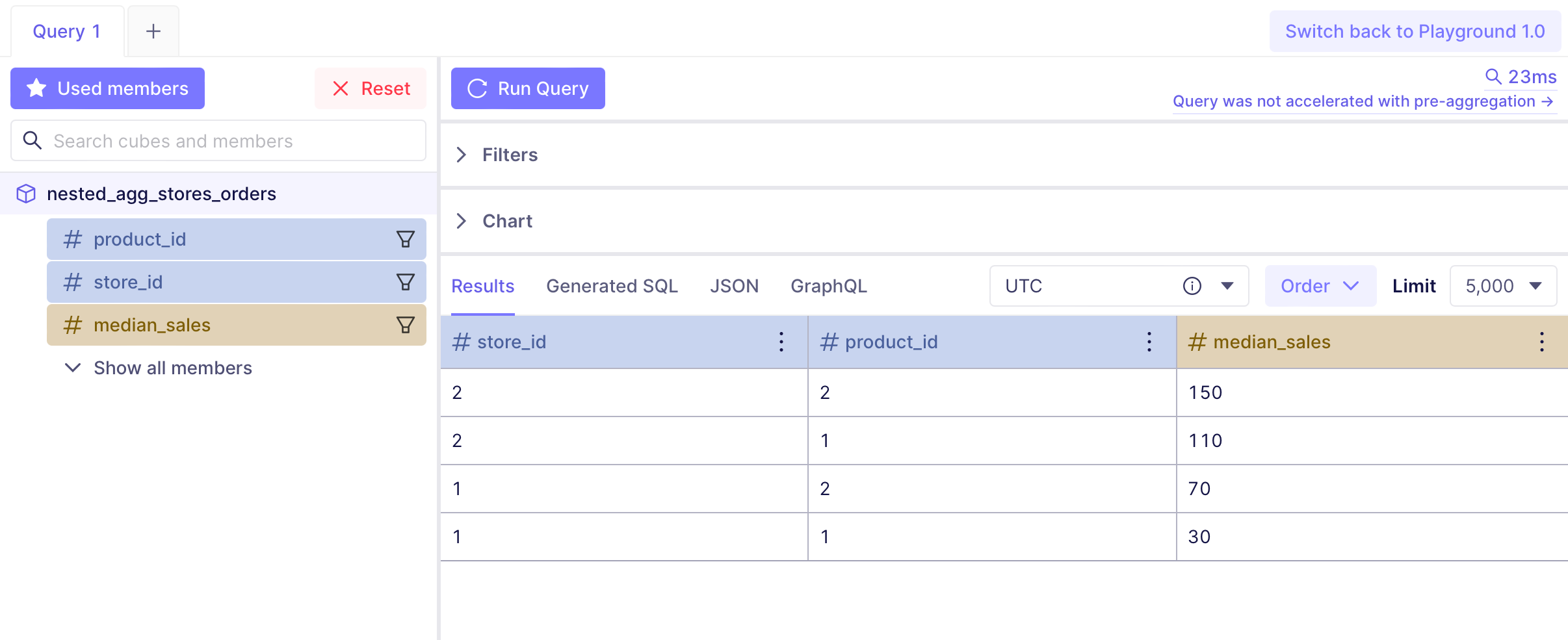
 We can verify that it's correct by adding one more dimension to the query:
 [ref-measures]: /reference/data-modeling/measures
[ref-cube]: /reference/data-modeling/cube
[ref-subquery-dimension]: /docs/data-modeling/dimensions#subquery-dimensions
[ref-measures]: /reference/data-modeling/measures
[ref-cube]: /reference/data-modeling/cube
[ref-subquery-dimension]: /docs/data-modeling/dimensions#subquery-dimensions